

ADHD and Video Games: Benefits, Risks, and How to Set Limits
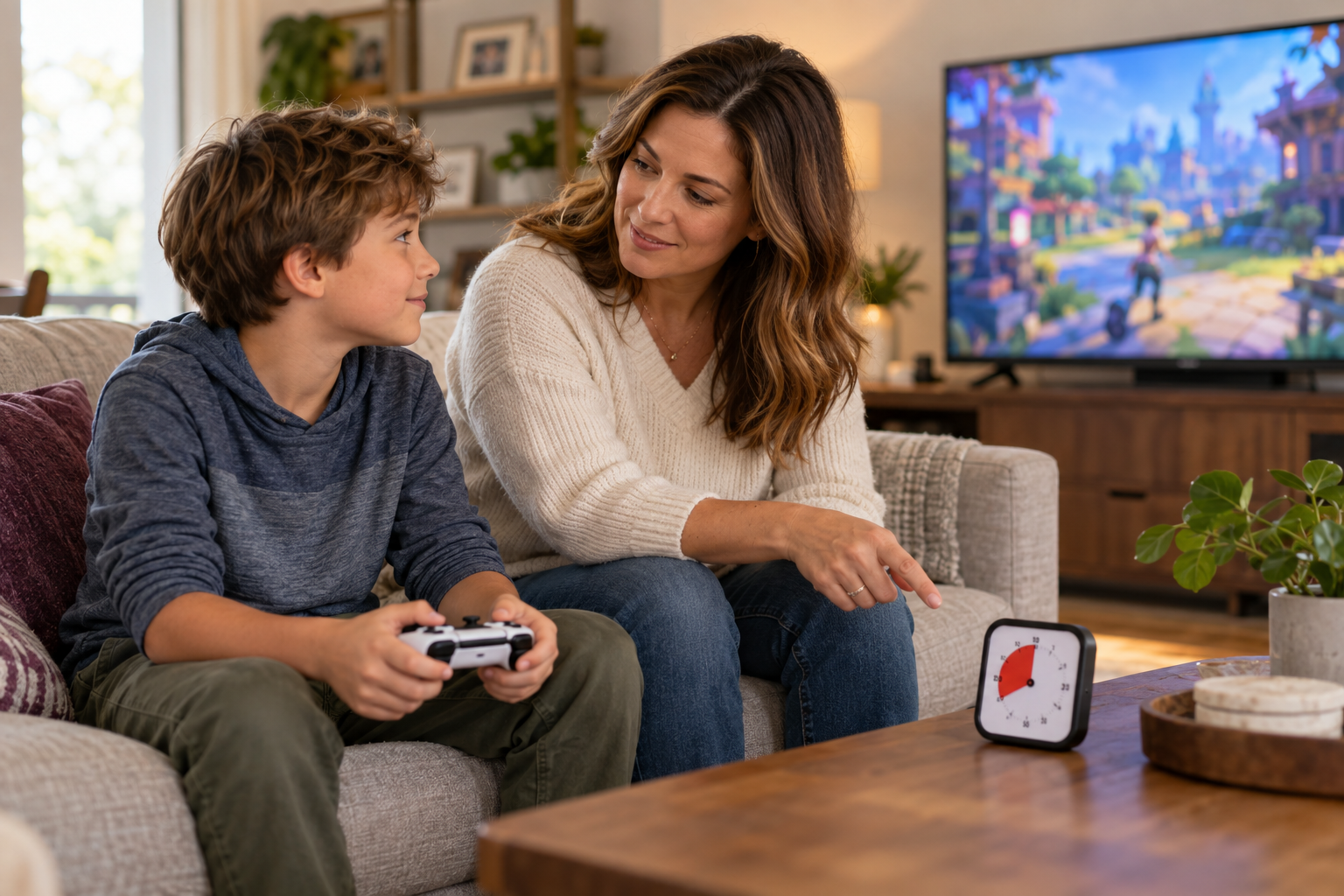
Why can your child focus on video games for hours but struggle with homework? Learn how ADHD, immediate rewards, game content, and predictable boundaries can shape your child’s gaming habits—and what parents can do to help.
“My child can play video games forever, but getting through homework feels impossible. How can that be ADHD?”
This is a common question from parents. Watching a child stay absorbed in a game can make their difficulties with schoolwork, chores, or everyday directions confusing.
Video games are often highly engaging. They provide clear goals, frequent feedback, changing challenges, and immediate rewards. Those features can hold attention in ways that a worksheet or getting ready for school may not.
The goal is to understand what makes gaming appealing while helping children develop habits that leave room for sleep, learning, movement, relationships, and other interests.
Enjoying video games does not automatically mean a child has an addiction. What matters is the pattern: what they play, how much they play, whether they can stop with support, and how gaming affects everyday life.
Why Can My Child Focus on Video Games but Struggle With Homework?
ADHD does not mean a child is unable to pay attention to anything. It can involve difficulty regulating attention, starting tasks, resisting distractions, and shifting away from an engaging activity.
A game may provide:
- Immediate feedback about what to do next
- Frequent rewards, achievements, and opportunities to try again
- Clear goals and visible progress
- Novelty, movement, sound, and changing challenges
- Social interaction or competition
Homework may require a child to organize materials, remember instructions, tolerate mistakes, and keep working toward a reward that is much farther away.
Being absorbed in a game also does not prove that a child is deliberately refusing to concentrate elsewhere. Different tasks place different demands on attention and self-management.
If attention difficulties are affecting school, home, or relationships, learn more about ADHD testing for children and teens. Gaming behavior alone cannot establish a diagnosis.
ADHD, Dopamine, and the Appeal of Immediate Rewards
Dopamine helps support processes involved in motivation, learning, and reward. ADHD involves differences in these systems, but describing it simply as “dopamine seeking” does not capture the whole condition.
For parents, the practical point is that video games offer frequent reinforcement. A child does something and quickly receives a response: points, a new level, an exciting animation, or another opportunity to succeed.
A systematic review of reinforcement and ADHD supports the importance of rewards and feedback in understanding behavior.
This helps explain why gaming can be easy to overconsume. Understanding that appeal is a starting point for setting limits without shaming the child.
Clinical perspective from Jeff LaPonsie, LMSW-C: Planned, supervised access is preferable to unrestricted gaming. Children benefit from knowing what they may play, when gaming is available, and how the activity will end.
Do Video Games Cause ADHD?
A child’s gaming habits cannot tell you what caused their attention difficulties. Research examining gaming and ADHD includes associations that do not, by themselves, establish cause and effect.
A study of gaming in children with and without ADHD discusses connections between ADHD symptoms and problematic gaming. These findings should not be interpreted as proof that ordinary video game use causes ADHD.
When a child is struggling, look at the broader picture: their developmental history, sleep, learning needs, emotional health, daily routines, and functioning across settings.
Not All Screen Time Is the Same
Building something in a creative game, playing cooperatively with a friend, completing an educational activity, and playing an intense competitive game are different experiences.
Consider:
- Content: Is the game appropriate for your child’s age and development?
- Experience: Is your child creating, learning, connecting, or repeatedly chasing rewards?
- Design: Does the game pressure players to keep playing, return every day, or spend money?
- Interactions: Who can communicate with your child?
- Response: How does your child feel and behave during and after play?
A game described as educational still needs limits. Recreational gaming can also be enjoyable and meaningful when it fits into a balanced day.
Monitor Violent Themes and Check Game Ratings
Some games contain intense violence, sexual content, strong language, substance use, or other mature material. Colorful graphics, popularity with classmates, or a familiar character do not guarantee that a game is appropriate for children.
Use the Entertainment Software Rating Board (ESRB) ratings guide to check the age category, content descriptors, and interactive elements.
- Everyone: Generally suitable for all ages, although some mild content may be present.
- Everyone 10+: Generally suitable for ages 10 and older.
- Teen: Generally suitable for ages 13 and older.
- Mature 17+: Generally suitable for ages 17 and older.
- Adults Only 18+: Intended for adults.
Look beyond the rating letter. Read descriptions of violence, sexual material, language, gambling-related content, and purchases. Also check whether the game permits communication with other players.
Watch gameplay or play together. Review privacy and parental-control settings, and periodically check what your child is accessing. Ratings are a starting point; your child’s development and response to the content also matter.
How Much Gaming Time Is Appropriate?
For school-age children and teens, current AAP guidance emphasizes the quality and context of media use, rather than one universal daily time limit for every child.
That does not mean unrestricted access. A family’s plan should protect sleep, physical activity, learning, meals, and relationships.
The AAP’s 5 C’s of media guidance encourages parents to consider the child, content, use of media for calming, what media crowds out, and communication.
Ask whether gaming is leaving enough time for the other things your child needs. If it regularly displaces those activities, the plan needs adjustment.
Can Video Game Time Be Used as a Reward?
Gaming can be a motivating privilege for some children. The key is to make the expectation specific and keep earned gaming within the family’s planned allowance.
Instead of “Be good and you can play,” identify a behavior your child understands and can practice.
Illustrative example: “First we’ll finish this short homework section together. Then you can use your planned gaming time. Before you start, we’ll agree on the game and stopping point.”
The exact task and allowance should fit the child. A reward plan should not require a child to overcome a learning difficulty or complete an overwhelming task without support.
- Break expectations into manageable steps.
- Give prompt, specific praise for progress.
- Make the reward predictable.
- Keep gaming within the established schedule.
- Include other rewards, such as choosing an activity or spending time together.
Schoolwork that remains unusually difficult may need assessment or accommodations, rather than a bigger reward.
Plan for Stopping Before Gaming Starts
A stopping plan is easier to discuss when everyone is calm. Agree on the available time, what counts as a stopping point, and what comes next.
- Choose the game together. Check content and whether sessions can be paused.
- Set the endpoint. Explain the time limit and avoid starting another round close to the end.
- Make time visible. Use a timer or other reminder your child understands.
- Give advance notice. Remind your child before the endpoint arrives.
- Offer a next activity. Have a concrete transition ready.
- Recognize the skill. Praise stopping and transitioning, even when the child is disappointed.
For online games, discuss round length and teammates’ expectations beforehand. Those factors can help shape the plan without making gaming open-ended.
An illustrative parent response might be:
“I know you want to keep playing. It’s hard to stop something fun. Our gaming time is finished.”
Acknowledge the feeling while maintaining the limit. If transitions repeatedly become unsafe or highly disruptive, seek help developing an individualized plan. KCFC provides support for emotional and behavioral challenges.
When Is Gaming Becoming a Problem?
Look at patterns over time rather than one difficult evening. Consider professional support when:
- Gaming repeatedly interferes with sleep, school, meals, or relationships.
- Your child has difficulty reducing play despite consistent support.
- Other valued activities are increasingly abandoned.
- Conflict is frequent, severe, or unsafe.
- Your child continues gaming despite significant consequences.
These concerns do not automatically establish a gaming-disorder diagnosis. A qualified professional can consider gaming alongside attention, mood, anxiety, sleep, learning, and family circumstances.
How KCFC Can Help
Kalamazoo Child & Family Counseling helps children, teens, and caregivers understand attention difficulties, emotional regulation, and behavioral challenges.
Depending on your child’s needs, services may include:
- ADHD testing and diagnostic clarification
- Child, teen, and family therapy
- Parent-Child Interaction Therapy for appropriate young children and caregivers
- Pediatric psychiatric medication management when clinically appropriate
Our team can help your family identify appropriate next steps. Call 269-615-7637 or explore our services to request care.
Frequently Asked Questions
Yes. Sustained attention to an engaging game does not rule out ADHD. Games provide immediate feedback and rewards, while homework and everyday tasks can require different attention and organizational skills. Diagnosis requires a broader clinical evaluation.
For some children, planned gaming can reinforce a specific, achievable behavior. Keep it within the family’s established allowance, provide support for difficult tasks, and include other rewarding activities.
Yes. Consider age appropriateness, violent or mature content, online interactions, purchases, and your child’s response. Check the ESRB rating and content descriptors, watch gameplay, and review parental controls.
Sources and Additional Information
- American Academy of Pediatrics: ADHD Myths and Misconceptions
- Reinforcement and Compensatory Mechanisms in ADHD: A Systematic Review
- Video Games in ADHD and Non-ADHD Children: Modalities of Use and Association With ADHD Symptoms
- American Academy of Pediatrics: Screen Time Guidelines
- American Academy of Pediatrics: The 5 C’s for School-Age Children
- ESRB: Video Game Ratings Guide
Clinically reviewed by Jeff LaPonsie, LMSW-C, Clinical Director at Kalamazoo Child & Family Counseling.
Important: The information on this page is provided for general educational purposes only and is not intended to diagnose, treat, or provide medical or mental health advice. This information is not a substitute for an evaluation, diagnosis, medical opinion, or treatment recommendation from a qualified healthcare professional. If your child is in immediate danger or experiencing a mental health emergency, call 911 or go to the nearest emergency department. In the United States, call or text 988 for the Suicide & Crisis Lifeline.